
Keycard Shell Review
Best for: Open-source + air-gapped
Score Breakdown
Quick Specs
Watch: Keycard Shell Review
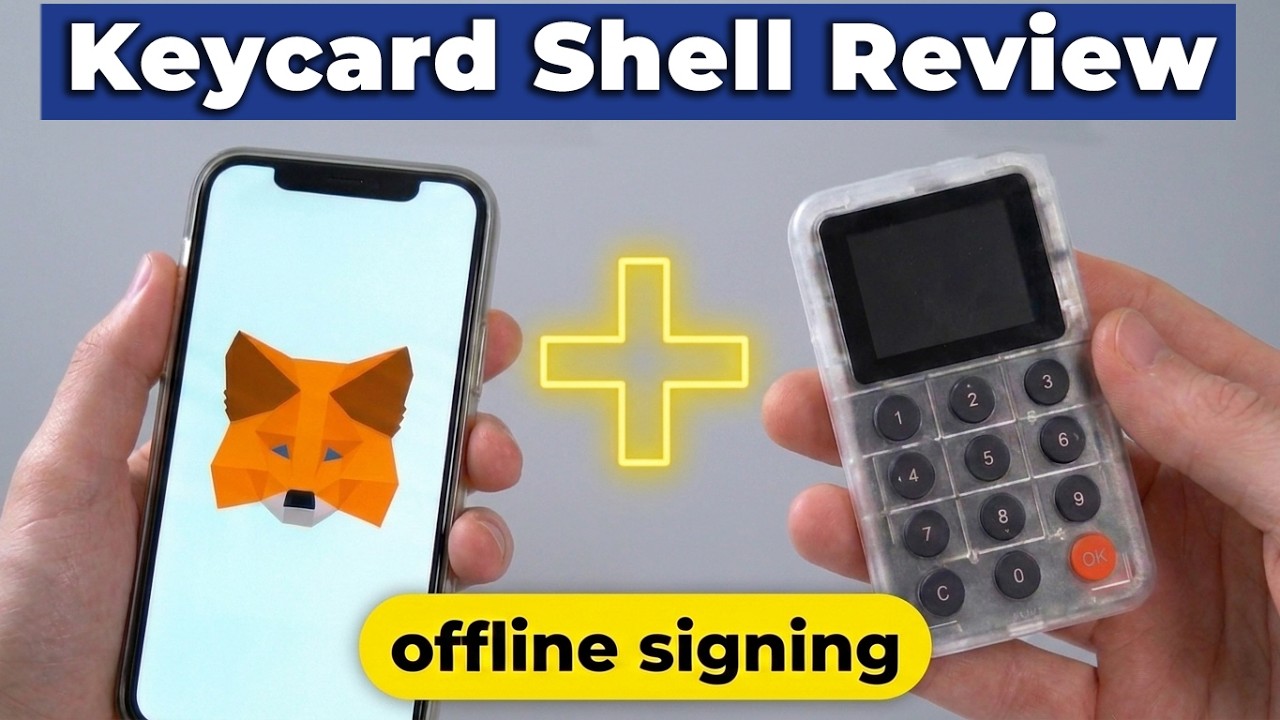
Hands-on video review of the Keycard Shell
Pros & Cons
Pros
- Fully open-source hardware and software (everything auditable on GitHub)
- Truly air-gapped with QR code communication only
- Modular and repairable design (replaceable battery, swappable Keycards)
- Keys never leave the EAL6+ secure element on the Keycard
- Stateless Shell design — all security lives on the Keycards
- Works with the software wallets you already use (MetaMask, Rabby, Sparrow, etc.)
- Clear signing on a proper screen (easy to verify transactions)
- Duress PIN feature for physical security scenarios
- Future-proof and community-supported if the company disappears
- Replaceable standard battery (not proprietary)
- Good value at ~$135 for Shell + 2 Keycards
- 5% discount available with code NORDIC
Cons
- QR code workflow takes a little getting used to at first
- No native Solana support yet (big limitation if you use Phantom or Solflare heavily)
- Plastic build feels functional rather than premium
- Newer product with limited long-term track record
- Requires a compatible software wallet that supports QR-based hardware wallets (Keystone-style)
- Physical buttons instead of touchscreen (some users prefer touch)
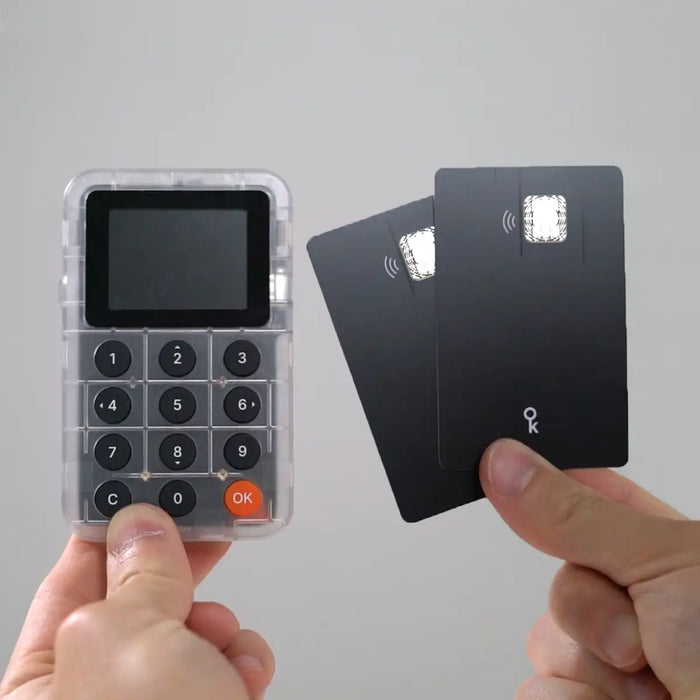
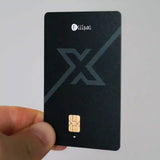
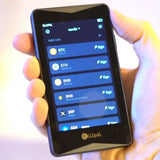
The Keycard Shell is a modular, fully open-source, air-gapped hardware signing device. What makes it different from anything else on the market is that it splits the wallet into two separate parts: the Keycards that hold your private keys, and the Shell that provides the screen and camera to use them. The security lives entirely on the small smart cards, and the Shell is completely stateless, it stores nothing sensitive at all.
What Is the Keycard Shell?
Open-source means all the code is published publicly on GitHub so anyone can audit it. Air-gapped means the device never connects to the internet or other devices via cables or wireless signals, it only communicates through QR codes scanned with its built-in camera. The Shell itself can be replaced or repaired without affecting your security, since all the sensitive data stays on the Keycards. It also includes a duress PIN that shows a decoy wallet if someone forces you to unlock the device.
Unboxing and Setup
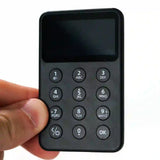
Inside the box you get a get-started QR code, the Keycard Shell device, a replaceable standard battery, a USB-C cable for charging, and two Keycards. Insert the battery by removing the back cover, slide a Keycard in until it clicks, and the screen turns on. Navigation uses physical buttons (up, down, left, right, and confirm).
For setup, insert a Keycard and set a PIN code. You can generate a new 12-word BIP-39 seed phrase, import an existing recovery phrase, or scan a QR code. Write the words down carefully on paper (or use multiple Keycards as physical backups), verify a few words on the device, and you're done. In settings you can manage the card and Shell separately, including authenticity verification by scanning QR codes.
Compatible Software Wallets
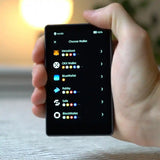
The Keycard Shell works through QR code signing with software wallets. It emulates the Keystone-style QR flow, so any wallet that supports Keystone QR hardware wallets will work. Main supported wallets include MetaMask, Rabby, imToken, Backpack, Bitget, Status Wallet, and Ambire for EVM chains. For Bitcoin it works with BlueWallet, Sparrow, Specter, Nunchuk, UniSat, Cove, and Bitcoin Safe. It currently does not have native Solana support.
Signing a Transaction
Connect to MetaMask by selecting QR-based hardware wallet and scanning the QR code shown on the Shell. Once connected, every transaction requires you to scan the transaction QR from MetaMask to the Shell, review the details on the screen, enter your PIN, confirm, and then scan the signed QR code back to MetaMask. This makes remote drains on your software wallet basically impossible as long as you control the physical device.
After One Week
What stands out most is how this approach turns your existing software wallet into something much closer to cold storage without forcing you to change your whole workflow. The security model is solid, keys never leave the EAL6+ card, the code is fully auditable, and the clear signing screen is excellent for verifying transaction details before approving.
The modular and future-proof design is a genuine differentiator. The replaceable battery and stateless Shell mean the device can last a very long time, and the open-source nature means the community can support it even if the company disappears. The QR flow takes a little getting used to at first, but it becomes second nature quickly. The biggest real limitation right now is the lack of native Solana support.
Verdict
Keycard Shell Discount Code
Get 5% off at checkout using the Keycard Shell discount code nordic.
The Keycard Shell is a well-thought-out hardware signing device that offers strong security through its open-source, air-gapped, and modular design while letting you continue using the software wallets you already know. It is especially appealing if you value repairability, open-source transparency, and don't want vendor lock-in. The main drawbacks are the QR workflow (which takes a little practice) and the current lack of native Solana support. If you mainly use Ethereum, L2s, and Bitcoin through MetaMask, Rabby, or Sparrow, this is a strong option worth considering, especially with the 5% discount using code nordic.
Watch before you buy:
Setup walkthrough:
Ready to buy the Keycard Shell?
Starting at $135. Check current price before you buy.
Buy Keycard Shell →Affiliate link · No extra cost to you
This page contains affiliate links. If you buy through them, I may earn a small commission at no extra cost to you. I only review products I have personally tested.